
Why Is Custom Framing So Expensive
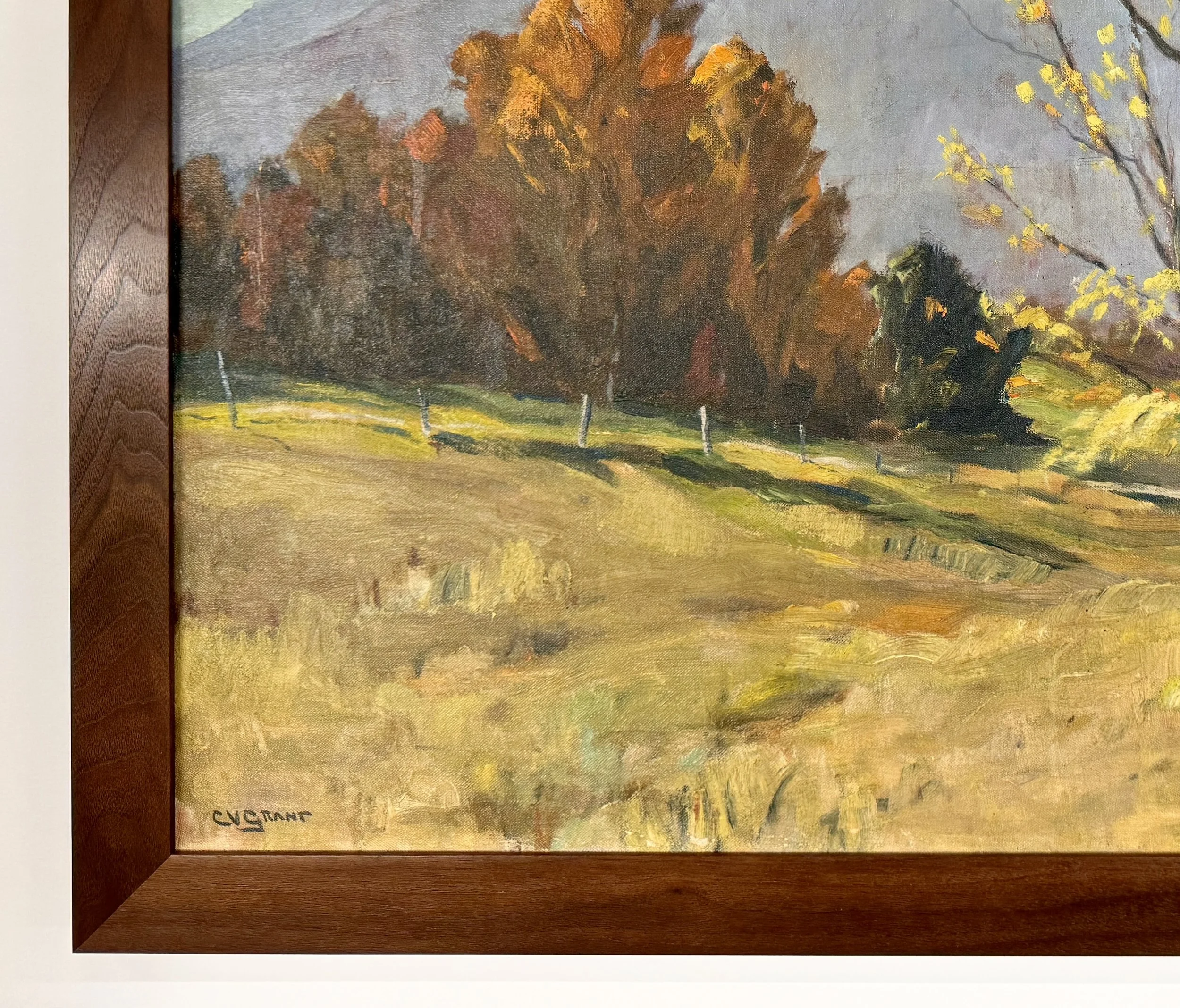
Solid Walnut Hardwood Frame
It’s a fair question. You can buy a black picture frame online for $30. You can also come into a custom frame shop, pick out what appears to be another black picture frame, and discover that it costs considerably more.
They’re both black. They both go around a picture. So what exactly are you paying for?
The short answer is that not all frames are the same—and quite a lot of custom framing is made up of things you’ll never see once the picture is hanging on your wall.
A black frame isn't just a black frame
Two frames can look similar in a photograph and be very different products.
An inexpensive frame might be made from particle board or another composite material covered with a thin decorative surface. Some are made from injected foam or other synthetic materials. They can be perfectly adequate for something temporary, but they aren't materials we choose for the custom framing we do.
The mouldings we use are made from wood. Depending on the frame, that might be a softer wood with a gessoed and painted finish, a stained wood that allows the grain to show, or a hardwood that can be stained or painted.
That difference becomes more apparent with time.
A well-made wood frame can be repaired, touched up, refinished and reused. A good hardwood frame is remarkably durable and resists the bowing, dents and damage that can happen with less substantial materials.
Take a look at the frames in an antique shop or at a yard sale sometime. Many have already held several generations' worth of artwork. Some are battered. Some desperately need cleaning. But they're still frames.
Good framing doesn't have to be disposable.
That's something we think is worth paying for—when the thing you're framing warrants it.
Does everything need expensive custom framing?
No.
We probably aren't supposed to say that, but no.
If you've got an inexpensive poster, you're decorating temporarily, or you're framing something you don't expect to keep very long, there are inexpensive ready-made and online options that may make perfect sense.
There is nothing wrong with matching the framing to the importance of the piece.
But if you're framing original artwork, an old photograph, a family document, a piece of needlework, a valuable print, an heirloom—or simply something you love and want to keep—then the conversation changes.
At that point, the question isn't only “What will look good around this?”
It's also “What should we do to this so it is still here years from now?”
Then there's the glass
Glass is another place where more expensive doesn't automatically mean better for every project.
We use conservation glazing because protection from ultraviolet light matters. And inexpensive artwork isn't necessarily immune from fading. In fact, a poster or print produced with inexpensive inks and paper can be particularly vulnerable. It doesn't have to be hanging in a sunny window to change over time; both UV and visible light contribute to fading and deterioration.
Then there is Museum Glass, which adds exceptional clarity and greatly reduces reflections.
Do we put Museum Glass on everything?
No. I don't even use it on everything I frame for myself.
But there are pieces where it makes an enormous difference. If you need to read what's behind the glass, see fine details, appreciate texture, or look closely at something like a textile, reducing reflection can transform the finished piece.
The right glass isn't automatically the most expensive glass.
It's the glass that's right for what you're framing and where it's going to hang.
Most of what protects your artwork is invisible
This is the part people don't see when they compare the price of a custom frame with a frame online.
Behind the pretty frame and mat are decisions about:
what materials should touch the artwork;
how it should be hinged, mounted or supported;
whether it should touch the glazing;
what backing materials should be used;
how much expansion and contraction need to be accommodated;
whether a mounting method should be reversible;
what type of glazing is appropriate;
how the finished piece should be sealed, fitted and hung.
Those aren't decorating decisions. They're preservation decisions.
And the correct answer changes depending on whether we're framing a photograph, a pastel, a watercolor, a newspaper, a diploma, an oil painting, a textile, a signed print, a piece of needlework or your cork collection from girls' night.
Yes, sometimes framing really is just being crafty.
Sometimes it isn't.
You're also paying for somebody to know the difference
I've been framing for 25 years, and I'm a Certified Picture Framer through the Professional Picture Framers Association.
That certification sounds fairly innocuous until you take the exam.
I've been to law school. I'm currently studying accounting with the eventual goal of taking the CPA exam. And the Certified Picture Framer exam remains one of the hardest tests I've taken.
A large part of what professional framers learn isn't how to make things pretty. It's understanding the materials we're entrusted with: paper, textiles, photographs and other substrates; how and why they deteriorate; what materials can damage them; and which techniques allow us to frame them without causing harm.
If you really want to go down the rabbit hole, ask a picture framer about lignin.
Actually, maybe don't.
So, why is custom framing expensive?
Because you're buying more than four pieces of moulding and a piece of glass.
You're buying materials chosen to last. You're buying something made specifically for your piece, rather than something manufactured to fit thousands of pieces approximately the same size. You're buying the labor required to build it. And you're paying for someone to make dozens of little decisions about materials and methods that you may never notice.
Those invisible decisions are often the most important part of the frame.
If what you're framing is temporary, replaceable or simply not that important to you, an inexpensive frame may be all you need.
But when the thing inside the frame matters, the question isn't just what the frame costs.
It's what you want that frame to do for the thing inside it.