
What’s Lurking Inside Your Picture Frame?
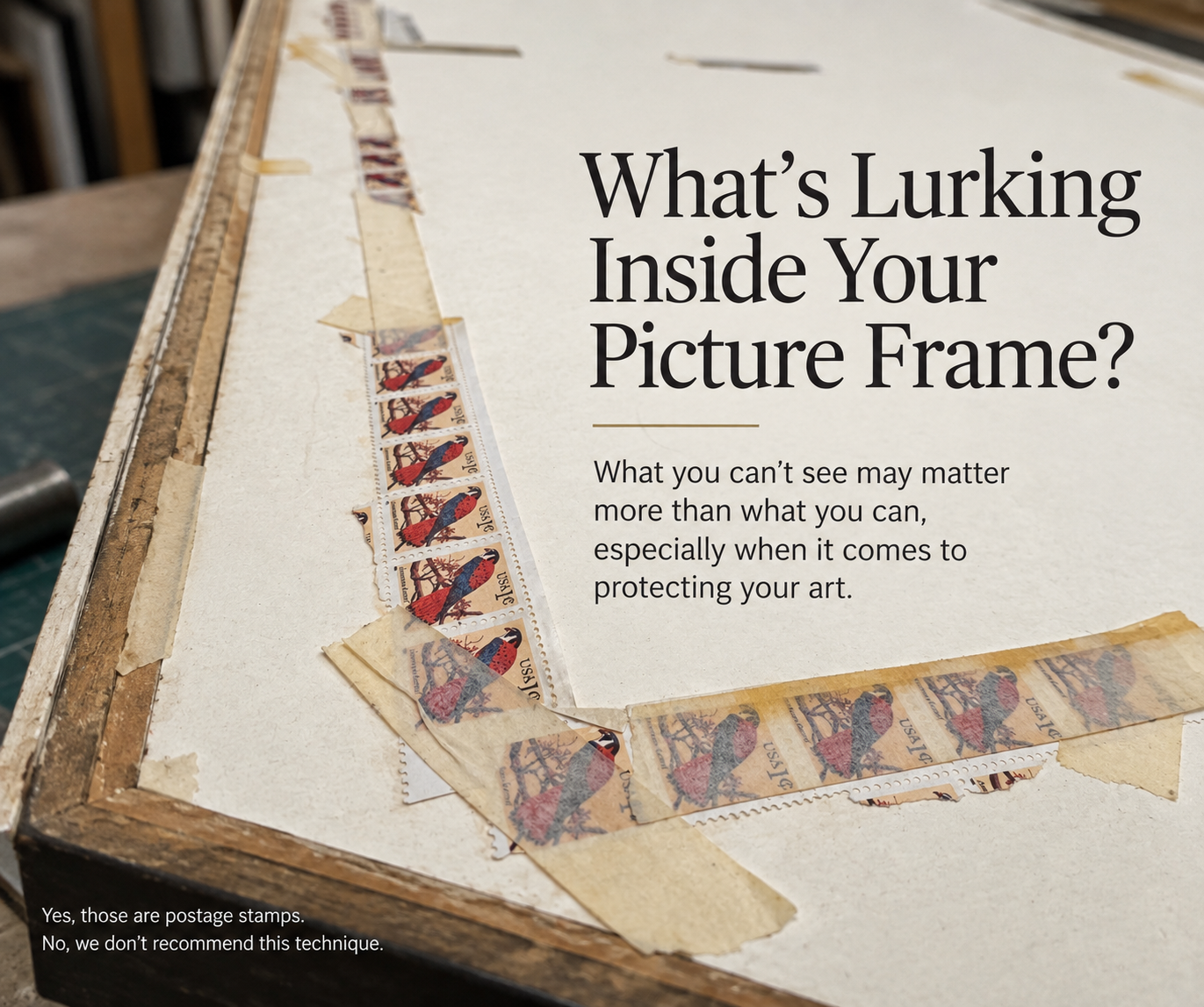
Stamps @#$%&! Seriously!?!
After 25 years of taking apart picture frames, you'd think we'd seen every possible mounting method.
Then we found postage stamps.
Yes, actual stamps.
This piece had previously been professionally framed, and stamps had been used to help hold the artwork in place. Creative? Absolutely. A conservation mounting method? Not so much.
One of the reasons we like opening older frames is that you really never know what someone before us decided was a perfectly reasonable solution.
What you can’t see may matter more than what you can, especially when it comes to protecting your art.
When most people look at a framed piece, they see the frame, the mat and the glass. We see all the stuff hiding behind them.
After more than 25 years of taking frames apart, we’ve encountered some interesting things back there. Cardboard. Masking tape. Duct tape. Glue. Staples in places staples really shouldn’t be. Materials that have turned brown and brittle with age. Artwork permanently stuck to things it was never supposed to be stuck to.
Sometimes we open an old frame and everything looks great.
Sometimes it’s a little scary.
The mat isn’t just there to look pretty
Choosing a mat color is the fun part, but matboard also serves an important purpose. It creates space between the artwork and the glazing and becomes part of the environment your artwork lives in for years.
Older and inexpensive framing materials can contain acids and other substances that discolor or damage artwork over time. If you’ve ever seen an old mat with a brown bevel or noticed discoloration around the edges of a print, you’ve seen some of what can happen as materials age.
That doesn’t mean every framed thing in your house is secretly being destroyed. It does mean the materials touching or surrounding something you care about are worth considering.
How your artwork is attached matters too
There are plenty of ways to make something stay put inside a frame.
That does not mean they're all good ways.
One of the things we think about when framing artwork is whether what we're doing can be reversed later. Your artwork shouldn't have to become a permanent part of its frame just because you wanted to hang it on the wall.
Different pieces require different solutions. A photograph, an original work on paper, a textile and a concert poster don't necessarily get treated the same way.
This is one of those parts of framing you'll probably never see.
That's kind of the point.
Glass is more complicated than it looks
There are different types of glazing for different purposes and budgets. Some reduce reflections. Some provide very high levels of UV protection. Museum glass can practically disappear under the right conditions.
Do you need the most expensive glass on everything you frame?
No.
We'd much rather help you figure out where spending more makes sense and where it doesn't. A valuable original watercolor and a funny print going in the guest bathroom don't necessarily need the same treatment.
Good framing isn't about choosing the most expensive option. It's about choosing the right option.
So does everything need conservation framing?
Nope.
If you're framing something replaceable and you're not particularly concerned about what it looks like 30 years from now, we'll take that into consideration.
But if it's original art, a family photograph, needlework that took hundreds of hours to make, a document you can't replace, or simply something that matters to you, what goes inside the frame deserves some thought.
That's one of the reasons custom framing can look deceptively simple from the outside. A lot of the work we're doing is specifically designed to be invisible.
And yes, we’ve found some frightening things
Taking apart old framing can be a bit like opening a time capsule.
We've found methods and materials that were perfectly normal decades ago but aren't considered appropriate today. We've also found some decidedly creative DIY solutions.
Sometimes the artwork is absolutely fine.
Sometimes we find damage that has already happened.
And sometimes we catch a problem before it becomes a bigger one.
That's why we don't assume an old frame needs to be replaced just because it's old. We take it apart, see what's actually going on and go from there.
Not sure what’s lurking inside yours?
If you have an older framed piece and you're wondering what's happening behind it, bring it into our shop in St. Johnsbury. We're happy to take a look.
Maybe everything inside is exactly as it should be.
Maybe we'll find something that should be changed.
Or maybe we'll discover something truly horrifying.